
Learning mathematics takes time, patience, and regular practice. Some students understand new concepts quickly, while others need a little more time to become comfortable with numbers, calculations, and basic arithmetic. That’s where online math practice platforms can make a difference.
The keyword xramath is closely related to searches for XtraMath, an online math practice platform designed to help students improve their basic arithmetic skills. It is useful to understand what the platform offers, how students can use it, and why short, consistent practice sessions can support mathematical learning.
What Is Xramath?
Xramath is a search term that may be used by people looking for XtraMath, an educational platform focused on improving basic math skills. XtraMath is a nonprofit organization that provides supplemental mathematics practice, mainly for students in kindergarten through Grade 8.
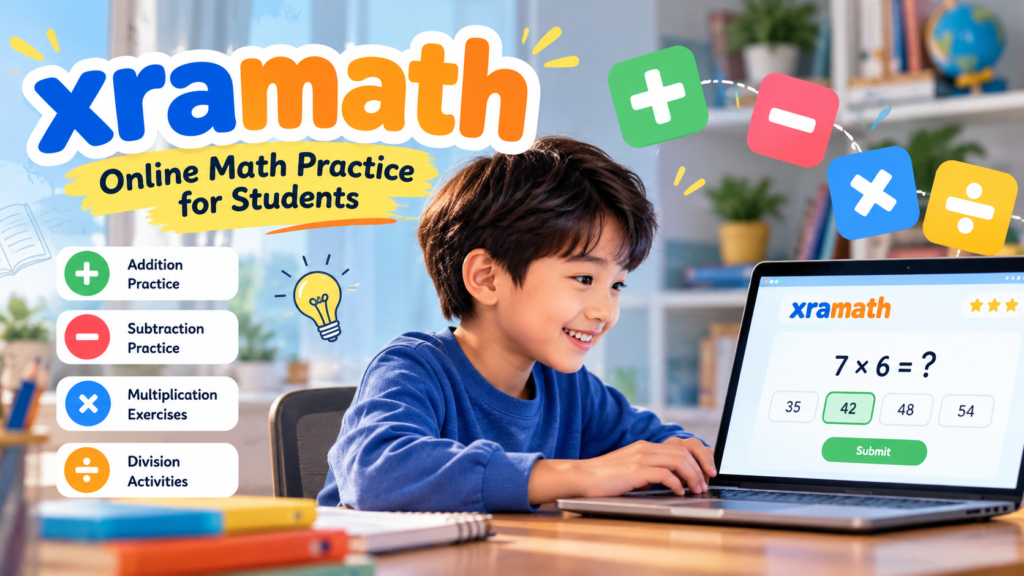
The platform focuses on four important arithmetic operations:
-
Addition: Learning to solve number combinations quickly.
-
Subtraction: Understanding the relationship between numbers and finding differences.
-
Multiplication: Building confidence with multiplication tables.
-
Division: Practicing basic division facts and number relationships.
The main idea is straightforward. Students practice regularly until basic calculations become easier to remember. They don’t have to spend as much time working out simple answers, which can help when they eventually face more challenging mathematics.
According to the official organization, XtraMath was founded in 2007 by David Jeschke and became a nonprofit organization in 2009. Its original purpose was to address the difficulty some elementary students experienced when recalling basic math facts.
How Does Xramath Work?
One interesting thing about XtraMath is that it doesn’t rely on complicated lessons or lengthy study sessions. Instead, it uses short practice activities to help students improve their recall.
The platform follows an adaptive learning approach. This means it considers how a student performs and adjusts the practice questions accordingly.
Here is a simple breakdown of the process:
-
Student access: The learner opens the platform using the account information provided by a parent or teacher.
-
Practice questions: The program displays arithmetic questions based on the assigned learning activity.
-
Student responses: The learner enters an answer using the available controls.
-
Instant feedback: The program indicates whether the answer is correct and helps the student recognize mistakes.
-
Progress monitoring: The system tracks performance and identifies facts that need additional practice.
XtraMath also uses spaced repetition. In simple terms, questions that a student finds difficult can appear again during later sessions. Questions that are already familiar receive less attention.
This approach helps learners revisit important information instead of simply moving through a fixed list of exercises.
Main Features of Xramath
A learning platform doesn’t need dozens of complicated features to be useful. Sometimes, a simple interface and a clear learning objective are enough.
XtraMath offers several features that make its practice activities useful for students, parents, and teachers.
| Feature | How It Helps Students |
|---|---|
| Addition practice | Improves recall of basic addition facts |
| Subtraction practice | Builds confidence with subtraction |
| Multiplication exercises | Helps students remember multiplication facts |
| Division activities | Develops familiarity with basic division |
| Adaptive questions | Focuses practice on areas needing improvement |
| Instant feedback | Helps students recognize incorrect answers |
| Progress reports | Allows teachers and parents to follow learning development |
| Short sessions | Makes regular practice easier to manage |
1. Practice for Four Arithmetic Operations
Students can work on addition, subtraction, multiplication, and division. These operations are essential because they appear in many other areas of mathematics.
For example, a student who understands multiplication facts may find certain fraction and algebra exercises easier to approach.
2. Personalized Practice
Not every student learns at the same speed. One learner might understand addition very well but struggle with multiplication.
Adaptive practice helps address this difference by giving students opportunities to revisit the facts they haven’t mastered.
3. Immediate Feedback
Feedback is another helpful feature. When students make mistakes, they can recognize them rather than continuing without understanding what went wrong.
And that’s important. Small mistakes can become habits if learners never receive an opportunity to correct them.
4. Student Progress Reports
Teachers and parents can use progress information to understand which arithmetic skills need additional attention. It also makes it easier to recognize improvements over time.
Why Is Regular Math Practice Important?
Mathematics is a subject where one skill often supports another. Students who struggle with basic calculations may find it harder to concentrate on more complicated questions.
Imagine solving a word problem that requires multiplication, subtraction, and division. If a student has to stop and calculate every basic fact, the entire exercise can become frustrating.
Regular practice can help reduce this difficulty.
Some important benefits include:
-
Better calculation speed: Students become more familiar with common number combinations.
-
Improved accuracy: Repeated practice provides opportunities to correct mistakes.
-
Stronger foundations: Basic arithmetic supports later mathematical learning.
-
Greater confidence: Familiarity with numbers can make classroom activities feel less intimidating.
-
Independent learning: Students can practice without needing someone to explain every question.
-
Consistent study habits: Short activities can encourage a regular learning routine.
But there’s something worth remembering: speed isn’t everything. Students should understand how mathematical operations work before being expected to recall answers quickly.
XtraMath itself explains that its purpose is to develop fact fluency rather than teach the underlying concepts of arithmetic.
How Students Can Get Started With Xramath
Getting started with an online learning platform is generally straightforward. Parents and teachers can help students access the appropriate account and choose suitable practice activities.
Here is a basic approach:
Step 1: Visit the Official Website
Start by visiting the official XtraMath website at XtraMath.org. Make sure you are using the correct website rather than an unrelated page with a similar name.
Step 2: Create or Access an Account
Parents can create an account for home learning, while students may receive login information through their school or teacher.
If a child already has a classroom account, using the same account at home can help keep their learning progress connected.
Step 3: Choose the Appropriate Practice
Students should work on the arithmetic operations that match their current abilities. Younger learners may begin with basic addition, while more experienced students can practice multiplication or division.
Step 4: Complete the Activities
Follow the instructions displayed on the screen and answer each question carefully. Students should focus on accuracy rather than rushing through every exercise.
Step 5: Review Learning Progress
Parents and teachers can check available progress information to identify improvements and areas that need further attention.
Note: Account options and available features may vary depending on whether the student uses a free account or a school license.
Xramath for Parents and Teachers
Parents and teachers play an important role in helping children develop positive learning habits. An online platform can provide practice, but students still benefit from encouragement and guidance.
For parents, XtraMath can be a useful addition to homework routines. Instead of asking children to complete a large number of worksheets every day, families can introduce a short practice session and gradually build consistency.
Teachers can also use the platform as a supplemental classroom activity. It gives students an opportunity to practice arithmetic while allowing educators to review their progress.
Here are a few practical suggestions:
-
Set a regular time for math practice.
-
Encourage children to understand questions before answering.
-
Avoid comparing one student’s progress with another’s.
-
Celebrate improvements, even when they seem small.
-
Discuss difficult questions instead of focusing only on incorrect answers.
-
Combine digital exercises with traditional worksheets and classroom activities.
And don’t forget to make learning enjoyable. A child who feels comfortable asking questions is more likely to develop a positive relationship with mathematics.
Xramath vs. Traditional Math Worksheets
Both digital exercises and traditional worksheets have a place in education. They simply offer different learning experiences.
| Comparison | Xramath / XtraMath | Traditional Worksheets |
|---|---|---|
| Learning method | Digital exercises | Printed questions |
| Feedback | Immediate program feedback | Usually checked by a teacher or parent |
| Progress monitoring | Digital progress information | Manual tracking |
| Accessibility | Requires a compatible device and internet | Can be completed offline |
| Practice style | Interactive question-based activities | Written exercises |
| Flexibility | Can be used at home or school | Can be used almost anywhere |
Neither approach is automatically better in every situation. Digital practice can make repeated questions more convenient, while worksheets give students opportunities to write calculations and demonstrate their working.
Using both methods can provide a more complete learning experience.
Is Xramath Suitable for Every Student?
XtraMath is primarily designed for elementary-level math practice, although older students may also benefit from reviewing basic arithmetic.
It can be particularly useful for:
-
Children who are learning addition and subtraction.
-
Students who need extra multiplication-table practice.
-
Learners who struggle to recall division facts.
-
Parents who want additional educational activities at home.
-
Teachers looking for supplemental arithmetic practice.
However, students who are learning more advanced topics may need additional resources. Geometry, algebra, fractions, and mathematical reasoning require explanations and problem-solving activities beyond basic fact practice.
That’s why XtraMath should be considered a supporting educational resource rather than a complete mathematics course.
Tips for Getting Better Results With Xramath
Simply opening an educational website doesn’t guarantee better learning outcomes. The way students use the platform matters too.
A few small changes can make regular practice more productive.
Keep sessions manageable: Short, consistent practice is generally easier to maintain than lengthy activities that leave children tired.
Focus on understanding: Students should know how to solve a calculation before trying to answer it quickly.
Practice difficult questions: Don’t ignore challenging number combinations. Give them additional attention.
Take breaks when necessary: If a child becomes frustrated, a short break can help them return with a clearer mind.
Track improvement: Look at progress over several sessions rather than judging performance based on one difficult day.
Parents should also remember that every child develops mathematical skills at a different pace. Patience and encouragement can make a real difference.
Frequently Asked Questions (FAQs)
1. What is xramath used for?
Xramath is a search term associated with XtraMath, an online educational resource for practicing basic arithmetic. The platform focuses on addition, subtraction, multiplication, and division.
2. Is XtraMath free to use?
Yes. XtraMath offers a free version for students and families. Optional paid licensing provides additional features for schools and educators.
3. Can students use XtraMath at home?
Yes. Students can practice at home using a compatible internet-connected device and the appropriate account information.
4. What age group is XtraMath designed for?
The platform primarily supports elementary-level learners, particularly students in kindergarten through Grade 6, although its supplemental program can also help older students who need arithmetic practice.
5. Does XtraMath teach advanced mathematics?
No. Its main purpose is to develop fluency with basic arithmetic facts. Students need additional lessons and learning resources for advanced mathematical subjects.
6. How much time should students spend practicing?
The official program promotes short daily practice sessions, generally around 10 minutes. Parents and teachers can adjust routines according to individual learning needs.
Final Thoughts
Xramath is a useful keyword for people searching for information about online math practice, particularly the XtraMath learning platform. Its main strength is its straightforward approach to arithmetic: students practice important number facts, receive feedback, and gradually develop stronger recall.
For parents, it offers another way to support children’s learning outside the classroom. For teachers, it can provide additional practice and useful information about student progress.
Of course, no digital platform can replace a good teacher, clear explanations, or hands-on learning. But when used alongside regular lessons and consistent encouragement, XtraMath can become a helpful part of a student’s mathematics routine.
The important thing is to build strong foundations, one calculation at a time.